
Vehicle Water Intrusion Testing
Feb 10th 2026
- Custom rain test systems can be installed in manufacturing facilities.
- On-site testing speeds up development cycles.
- Water reclamation controls testing costs.
- On-demand testing enables better compliance.
- Testing can apply to entire vehicles and vehicle components
NS Corporation has built an operational water intrusion testing system for train car manufacturing in Maryland. The completed project opens doors to more systems for a broader range of applications.
Learn more about rain testing, how it works, and what it could do for you.
What Is a Rain Test System?
Rain testing systems, sometimes also called water intrusion testing systems, simulate rain for the sake of testing products or prototypes. In the vehicle industry, most rain tests focus on water intrusion in different elements of a vehicle.
For example, a sedan manufacturer will want to see how water can intrude into the cap of a vehicle. They may also look at water intrusion under the hood and in the undercarriage of the car.
Rain testers can spray variable volumes of water at variable pressures from different angles, all on demand.
Interestingly enough, rain testers benefit from many of the same designs and concepts that apply to car washes. In general, a vehicle that performs well in a car wash will do well in the rain, but these testing systems get more specific.
Transit vehicle wash equipment can be redesigned and repurposed to simulate real-world rain very accurately and effectively. At the same time, water reclamation and other proven designs can help control testing costs.
Hitachi Rail
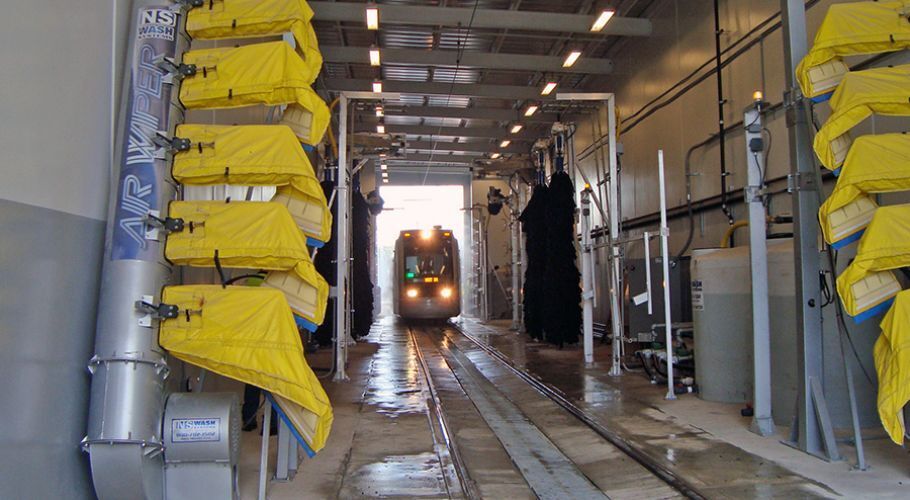
NS Corporation built a rain testing system for the Hitachi Rail manufacturing center in Maryland. This specific facility tests train cars of various designs in a number of water-intrusion scenarios. At the plant, they can test high-speed rail cars, commuters, trams, monorails, and more.
The water intrusion testing system takes inspiration from car wash designs to create 75 horsepower pumps that can deliver high-pressure and variable-pressure water. A below-ground water recovery system minimizes the tests’ footprints and saves on water costs.
The Hitachi test system primarily looks at water intrusion for train car components (such as electrical or other complicated components) and passenger compartments.
The system allows Hitachi to test cars onsite after production or prototyping.
Applications for Vehicle Testing
Looking ahead, similar testing systems for vehicle manufacturers could apply to virtually any vehicle, from sedans to shipping trucks, train cars, and more.
Rain simulation shows waterproofing performance in any component of the vehicle, allowing for precise performance ratings and standards compliance. Regardless of vehicle size or shape, a system can accommodate your vehicles to create thorough, on-site testing at your existing facilities.
The Importance of Water Intrusion Testing
Customized rain testing systems open doors for vehicle manufacturers, designers, and testers.
For starters, compliance becomes that much easier. When specific water intrusion needs arise, you can verify performance in your own facility, simplifying testing and speeding up iteration cycles.
Even beyond regulations, if you want to chase third-party certifications as proof of quality, you can ensure performance before spending money on third-party testing. This achieves certification faster and with less cost.
Most importantly, on-site testing allows you to chase safety and performance standards on your own terms. Well beyond the minimums in regulations and the standards set by other bodies, you can determine the performance that meets your own standards and ensure that you have achieved them.
The Big Picture
While all of this applies to vehicle rain testing, there’s a larger picture at play. For any designer or manufacturer, specified water intrusion testing opens up new doors.
You can speed up your innovation cycles. No longer waiting on weather patterns or third-party testers, you can see exactly how your prototypes perform as soon as they’re ready for the test.
On-site testing minimizes setup and transportation times, allowing you to perform more tests on a tighter schedule.
Cross-industry testing means that a single rain simulator can apply to more than just one vehicle design or type. You can simulate rain for smaller components, like EV batteries or autonomous vehicle sensors. You could even potentially rent out your testing facility to non-vehicle manufacturers to rain test their designs.
Capping all of it, efficient, proven design elements make your testing equipment more sustainable.
To learn more about how NS Corporation can help with designing and constructing water intrusion testing or train wash systems, please contact us to discuss your project.